
10 ways to fireproof your home Before Wildfire Season
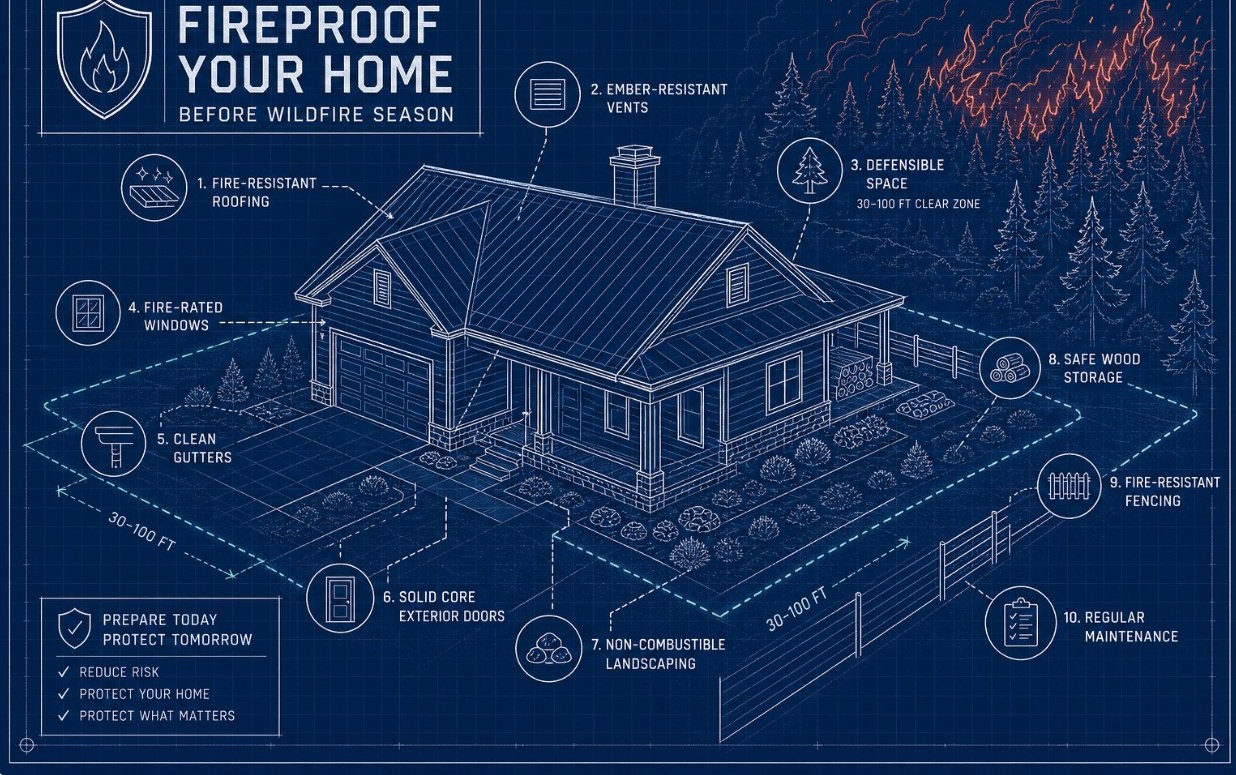
10 ways to Fireproof your home before Wildfire Season.
Wildfire season in Northern California no longer has an off-switch. Red flag warnings, back-to-back dry years, and PG&E Public Safety Power Shutoff events have turned home fire preparedness into a year-round discipline. Most homeowners take one or two steps, clearing brush, buying a smoke detector, and then feel done. They're not.
A truly wildfire-resilient, fireproof-safe home has layers: hardened materials on the outside, maintained clearance around the perimeter, documents secured in a quality fire-resistant safe for your home, and continuous power for the systems that keep your family informed when the grid goes down. Some of these steps cost almost nothing. Others are real investments. A few are deeply overlooked, including the energy resilience piece, where a local resource like Arthur Walsh at EcoArthur comes in. By the end of this guide, you'll have a clear, prioritized action plan across all 10 layers.
Ways 1, 3: Hardening Your Home's Exterior Against Ember Intrusion
Most homes ignite not from direct flame contact but from airborne embers landing on or entering vulnerable surfaces. These three structural upgrades block the most common fire pathway into a home.
1. Upgrade to Class A Roofing
Roofing material is the single highest-impact exterior change you can make. Class A fire-rated options, metal, concrete tile, clay tile, and Class A composite shingles, dramatically reduce ignition risk compared to wood shakes. Metal roofing and concrete tile are both excellent choices for Northern California's high-hazard severity zones. The cost is real, but framing it as a deferred replacement rather than an optional upgrade makes the math easier to justify.
2. Replace Combustible Siding
Fiber cement siding and stucco are the two most practical alternatives to wood-based finishes. Both are non-combustible and widely available from contractors in the Bay Area. If a full siding replacement isn't in the budget this season, prioritize the walls that face prevailing wind and fire approach directions first.
3. Seal Vents, Eaves, and Gaps Before Ember Season
Most home fire losses start from embers entering through soffit vents, attic vents, or gaps around window frames. Ember-resistant mesh vent covers are inexpensive and easy to install. Walk your exterior perimeter with fresh eyes before fire season: look for open eaves, gaps at the roof-wall junction, and unscreened vents. A single afternoon of caulk and mesh installation can close vulnerabilities that have been there for years.
Ways 4, 5: The Two-Zone Defensible Space Strategy That Buys Time
California's defensible space law (Public Resources Code 4291) establishes a two-zone model that is legally required in many fire hazard severity zones. Many homeowners have heard of it. Far fewer actually maintain it correctly year to year. For official guidance on the two-zone framework, review [Cal Fire's defensible space zones](https://bof.fire.ca.gov/projects-and-programs/defensible-space-zones-0-1-and-2).
4. Zone 1 (0, 30 Feet): Build an Ember-Resistant Perimeter
**Zone 1 is the "lean, clean, and green" zone** directly surrounding your home. Use non-combustible mulch or gravel within the first 5 feet of the structure, keep dense shrubs away from exterior walls, and space low-growing vegetation widely enough that fire can't jump from plant to plant. One important clarification: "green" does not mean "fire-resistant." Healthy, irrigated plants still burn. Species selection and spacing both matter here, not just the color of the foliage.
5. Zone 2 (30, 100 Feet): Reduce Fuel and Interrupt Fire Spread
Zone 2 is about slowing the rate at which fire approaches your home, giving you and firefighters more time to respond. Thin vegetation into islands rather than continuous masses. Prune tree canopies so the lowest branches are at least 6, 10 feet off the ground, eliminating the ladder fuels that carry ground fire into the canopy. On slopes, fire accelerates dramatically as it moves uphill, so hillside properties in Northern California often benefit from clearance well beyond the 100-foot minimum.
Ways 6, 7: Choosing a Fireproof Safe for Your Home That Actually Protects What Matters
This is the step most wildfire prep guides skip or handle poorly. The word "fireproof" on a product label is marketing language, not a certification. "Fire-resistant" is the accurate term, and what it means in practice depends entirely on what rating system was used and what you're storing inside. Selecting the right home fireproof safe is one of the most important and underappreciated decisions in any wildfire preparedness plan.
It protects things like the
- house deed
- proof of ownerships of items that will be replaced in a fire
- trust's
- will's
- essential documents.
6. Decode UL Fire Ratings Before You Buy a Fire-Resistant Safe for Your Home
UL fire ratings have two components: time and internal temperature. **UL Class 350** means the interior stays below 350°F for the rated duration, sufficient for paper documents. **UL Class 125** means the interior stays below 125°F, which is what USB drives, external hard drives, CDs, and printed photos actually require to survive. The practical rule: base your safe choice on the most heat-sensitive item you plan to store. The fire-resistant safe most homeowners buy protects paper just fine and destroys digital media entirely. For a deeper explainer on how UL and ETL ratings translate to real-world protection, see [understanding UL and ETL ratings for your home safe](https://www.libertysafe.com/blogs/the-vault/understanding-ul-and-etl-ratings-for-your-home-safe).
Real-world failure modes are worth knowing before you buy. Water intrusion from firefighting hoses can damage contents even when the outer shell survives. Structural collapse can drop a safe through a floor, warping doors and latching mechanisms. A safe that survives a fire may not open easily afterward. These aren't reasons to skip buying one. They're reasons to choose a well-rated model and understand its limits. A waterproof and fireproof safe with a UL water-resistance rating adds meaningful protection against both threats.
7. Match a Fireproof Safe for Your Home to Your Budget and Contents
Three categories cover most households:
- **Document safes** (roughly 0.25, 0.66 cu. ft., $32, $88): handle passports, birth certificates, and paper records, a reliable fire safe for valuables on a tight budget.
- **Chest safes / fireproof chests** (1, 2 cu. ft., $40, $150+): fit legal files and small electronics.
- **Full-size home safes** (2, 4+ cu. ft., $300, $2,000+): offer comprehensive storage for documents, jewelry, and digital media.
The SentrySafe SFW123GDC consistently ranks as a top-rated home fireproof safe across multiple independent reviews, including testing by Wirecutter and Consumer Reports, with UL classification, water resistance, and drop-test performance all covered. For consumer-oriented comparisons of top-rated models, see this roundup of the [best fireproof home safes](https://www.popularmechanics.com/home/interior-projects/a45559412/best-fireproof-home-safes/), and if you want to review a common compact model's specifications, the SentrySafe 0.61 cu. ft. file box is available at major retailers like [Home Depot](https://www.homedepot.com/p/SentrySafe-0-61-cu-ft-Fireproof-Safe-File-Box-1170/203028068).
Warranty terms differ meaningfully by brand:
- **SentrySafe** offers after-fire safe replacement plus optional contents reimbursement programs on registered models.
- **Liberty Safe** provides lifetime warranties with after-fire replacement on qualifying units.
- **Honeywell** typically offers a standard limited warranty without a formal after-fire replacement program.
Register your safe the day you buy it, and keep the purchase receipt in a separate location, not inside the safe itself.
Ways 8, 9: What Happens to Your Home Security When PG&E Cuts Power
This is the layer most wildfire preparedness guides skip entirely. A Public Safety Power Shutoff doesn't just turn off the lights. It takes down everything that doesn't have its own battery: security cameras, alarm systems, smart locks, refrigerated medications, medical equipment, Wi-Fi, and phone chargers. Red flag conditions, the exact conditions that trigger PSPS events, are when those systems are most critical. Losing them simultaneously is not a minor inconvenience. It's a gap in your preparedness posture that most homeowners don't notice until after their first shutoff. For context on how headlines and utility actions affect local outages, see [Headlines that effect your Power, EcoArthur](https://ecoarthur.com/headlines-that-effect-your-power/).
8. Identify Your Critical Circuits Before the Next Shutoff
Walk through your home and list every system that needs power during a fire emergency: alarm panels, exterior cameras, a router, medical equipment, and a phone charger at minimum. PSPS events in Northern California have lasted anywhere from a few hours to several days. Knowing which circuits matter most is the first step toward backing them up reliably.
9. A Solar Battery Keeps Critical Systems Running, and the Cost May Surprise You
**A home solar battery system keeps selected circuits live when the grid goes dark.** Security cameras and alarms stay active. Devices stay charged. Arthur Walsh at EcoArthur sizes each system to your home's specific loads and risk profile, not a one-size package, designed for wildfire-risk homeowners in the North Bay Area through Powur and Sunrun, with capacity to power critical loads for 12, 24+ hours during a PSPS event. Learn more about how [solar batteries can power your home during public safety power shutoffs](https://www.sunrun.com/go-solar-center/solar-batteries-power-your-home-during-public-safety-power-shutoffs-psps), and for a broader case of why distributed solar is a strong fit locally, read [Why Solar Power is Perfect for California, EcoArthur](https://ecoarthur.com/why-solar-power-is-perfect-for-california/).
California's Self-Generation Incentive Program (SGIP) can significantly offset the cost of battery storage for qualifying homeowners, making this step far more accessible than most people assume. If you've been treating battery backup as a future upgrade, it's worth getting an actual number from a local consultant before fire season peaks.
Way 10: Evacuation Readiness and Your Documentation Checklist
Build Your Go-Bag Around Your Fire-Resistant Safe for Your Home
A well-stocked fireproof safe for your home should hold: passports, birth certificates, property deeds, insurance policies, Social Security cards, and a digital backup on a UL Class 125-rated media safe or encrypted cloud copy. Treat the safe as the physical anchor of your evacuation plan, the core of what gets grabbed first, or stays protected if you can't get out. Label folders clearly and keep high-priority documents at the front. Don't overfill it; an organized safe is a usable safe under pressure.
Document Your Valuables Before the Season Starts
Do a room-by-room home inventory on video and store it in cloud backup or a separate physical location. Insurers respond to documented claims far better than to memory-based estimates. A quality fire-resistant safe combined with thorough documentation creates a recovery foundation that most households don't build until after they've experienced a loss, which is exactly when it's too late to build it.
Putting Your 10-Step Wildfire Plan Into Action
Not every homeowner can complete all 10 steps this month, and that's fine. The goal is meaningful progress, not paralysis. Start with defensible space: it costs almost nothing and delivers high impact immediately. Add exterior sealing next, since vent covers and caulk are low-cost and DIY-friendly. Pick up a fireproof safe for your home for under $100 this week and populate it with your critical papers before the weekend is over.
From there, move into the larger investments: exterior material upgrades and battery storage. Both require planning and budget, but both also carry long-term financial benefits, materials through reduced insurance premiums in many cases, and battery storage through California incentives and locked-in energy costs. Each step you complete adds meaningful protection, even without finishing all 10. For guidance on long-term planning and organizing incremental steps, consider this local resource on [6 steps to build a sustainable business, EcoArthur](https://ecoarthur.com/6-steps-to-build-a-sustainable-business/), which outlines a pragmatic approach to staged investments and resilience thinking.
For the battery backup piece, Arthur Walsh at EcoArthur offers free solar savings and backup consultations specifically for North Bay Area homeowners. The conversation starts with your current utility bill and your risk profile, not a product catalog. Reach out at EcoArthur before fire season peaks. That consultation tends to take longer to schedule once red flag season begins.
10 ways to Fireproof your home before Wildfire Season.
Fire Season Doesn't Wait for a Convenient Time
Wildfire preparedness isn't one action. It's a stack of decisions that compound over time. The homes that fare best combine hardened exteriors, maintained clearance zones, documents protected in a quality fire-rated safe, and continuous power for the systems that keep a family informed and secure. No single layer is sufficient on its own. Together, they change the outcome.
For North Bay Area homeowners, the energy resilience piece is often the last thing people think about and the first thing that matters when PG&E turns off the grid at 10 PM on a dry October night. A fire-resistant safe for your home and a reliable battery backup system are two pieces of the same puzzle: protecting what matters most when the situation is completely outside your control. Start now, not because fire season is already here, but because the preparation that actually works takes longer than a week to build.