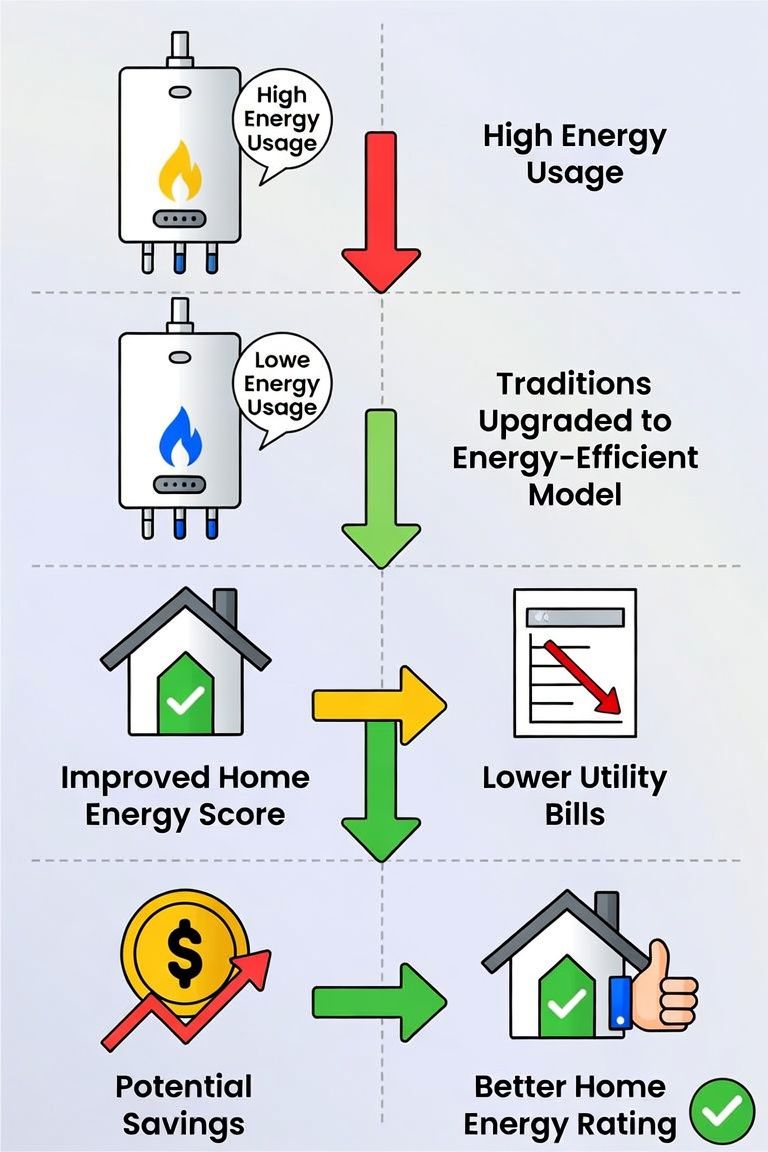
3rd Way to Improve Home Energy Score
The first two are about the shell of the house: seal the big air leaks, then insulate the attic. Those two stop conditioned air from leaving and outside air from pouring in, which is why they come first. A tighter, better-insulated house uses less heating and cooling, and it makes every later upgrade work harder.
The water heater is next because it is usually the second-largest energy user in the house, after heating and cooling. The Department of Energy puts water heating at about 12 to 18 percent of a typical home’s energy. On a Home Energy Score, the assessor records the type of water heater, its fuel, and its efficiency. An old standard tank is a visible drag on the score. A heat pump or high-efficiency unit is one of the cleaner ways to move that line.
Most people only replace a water heater when the shower goes cold or a puddle shows up on the garage floor. By then the job is an emergency, and the truck usually carries a like-for-like tank. Planned as step three, after the envelope work, it is a different project: lower bills, fewer cold showers, and a unit that lasts longer than the one it replaces.
Why it moves the score
An aging tank spends a lot of its energy just keeping water hot when nobody is using it. That standby loss shows up on the utility bill every month and on the energy model as a weak water-heating score.
The biggest jump is from an old electric resistance tank to a heat pump water heater. A standard electric tank can use roughly 4,000 to 5,000 kilowatt-hours a year. An ENERGY STAR heat pump model does the same job with about a quarter of that energy, because it moves heat from the surrounding air instead of making heat with an element. ENERGY STAR estimates about $550 a year in savings for a household of four versus a standard electric unit, and more than $5,600 over the life of the appliance, with payback often around three years.
Gas is closer, but the upgrade still pays in many homes. In the San Francisco Bay Area, an RMI analysis found that about 19 of every 20 homes would lower their energy bill by replacing a gas water heater with a heat pump model, with average savings around $360 a year. Tankless gas does not match that, but it still beats a conventional tank: it heats only when a tap opens, so standby loss goes away. The Department of Energy puts tankless units about 24 to 34 percent more efficient than storage tanks for many households, and higher when hot-water use is moderate.
A new high-efficiency tank is the modest middle step. Better insulation and a higher energy factor still cut standby loss versus a 12-year-old unit, often enough to save on the order of $100 a year without changing fuel or footprint.
Hot water that keeps up
Score and comfort are not the same complaint. A storage tank has a fixed reserve. Once the household showers, starts the dishwasher, and runs a load of laundry, recovery time is the wait. Tankless systems do not store a tank of hot water. Sized for the fixtures that run at once, they keep delivering.
A larger or better-insulated tank is the simpler fix when the problem is capacity. Heat pump models are still storage tanks, so recovery rate matters, but many include a resistance backup for high-demand periods. The right step-three upgrade depends on how many bathrooms run together, not on which brochure is newest.
Fewer emergencies, longer life
A conventional tank typically lasts 8 to 12 years. Sediment, corrosion, and a tired anode rod end most of them, often with a leak. Tankless units commonly run 20 years with periodic descaling, especially in harder water. Heat pump tanks generally land in the 10- to 15-year range, with warranties that often cover the tank for 6 to 12 years.
Replacing on your schedule also means you can fix what shortens life: a missing expansion tank, no drain pan, poor venting, or a unit in a flood-prone corner. Waiting for failure usually means an emergency install of whatever is on the truck.
Space and safety
A 40- or 50-gallon tank is a bulky cylinder. A wall-hung tankless unit is roughly the size of a carry-on and frees floor space in a garage or closet. Newer equipment also improves on old failure modes: modern temperature-and-pressure relief valves, better flue design, and sealed combustion on many high-efficiency gas models. Heat pump units pull heat from the air around them, which can slightly cool and dehumidify a garage or basement. Moving off gas also removes a combustion appliance that adds nitrogen dioxide indoors.
What counts as the upgrade
Matching the old model’s size and fuel is a replacement. Step three is a step up:
- Heat pump (hybrid electric). Best efficiency if you currently have electric resistance, and often a bill cut even against gas in higher-rate areas. Needs enough air volume around the unit and a condensate drain.
- Tankless gas or electric. Best when the complaint is running out, or when you want the floor space back. Gas tankless needs adequate gas supply and venting; electric tankless can demand a heavy electrical service.
- High-efficiency storage tank. Lowest disruption. Better insulation, sometimes a powered anode, same footprint and connections.
Local utility rebates still exist even though the federal 25C credit for heat pump water heaters does not apply to equipment placed in service after December 31, 2025. Check the utility before you buy.
If the unit is over 10 years old, the showers run short, or water heating is a stubborn line on the bill, price the efficient option next to the like-for-like swap. The efficient unit costs more on day one. On a lot of homes it is the one that costs less by year three, and it is the equipment upgrade that belongs on the list right after the house is sealed and the attic is insulated.
For more information on how to obtain your Home Energy Score